

Remarkably Well
People are asking how I’m doing. My knee-jerk —or should I say, hip-jerk—answer: I’m doing remarkably well.
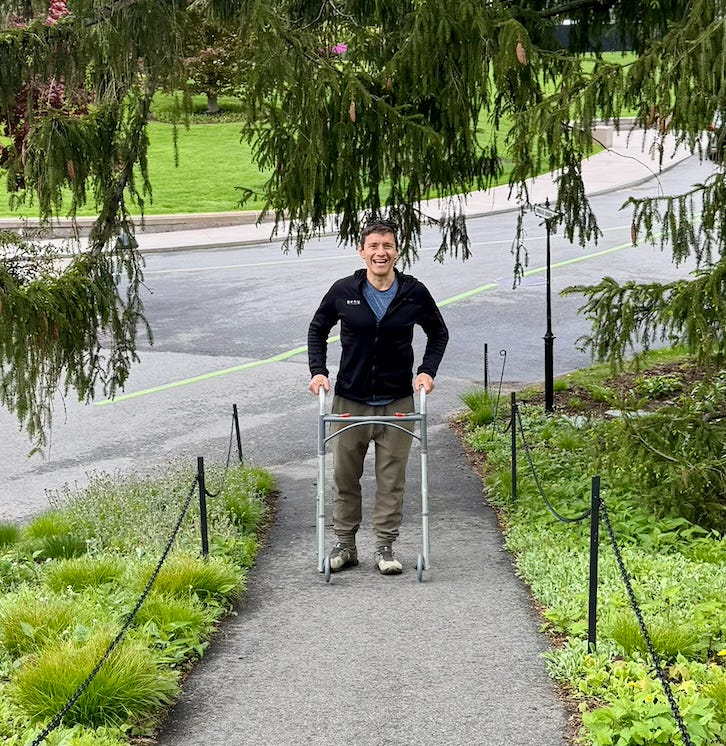
I can’t believe how much progress I’ve made in just over a week. From swollen, weak, and nearly immovable, to walking around without any assistance, going up and down stairs, and—other than treating the incision wounds and some lingering edema—feeling like a functional leg again.
It’s amazing how quickly a healthy body returns to health. I shouldn’t be surprised, but I am. I expected more pain, discomfort, disability, and distress. Expectations are funny.
The Pain You Sign Up For
This was pain that I signed up for. It was deliberate and intentional. I had time to prepare—physically, mentally, and emotionally. It doesn’t change the pain itself, but it creates a container that allows me to hold this experience in a particular way.
I had time to grieve the loss of my old hip. I had time to clear my schedule and create space for healing. I had time to arrange help—mostly Claire, god bless her heart—for the tasks I knew I’d be too immobile or tired to do. All of these preparations really made a huge difference in my experience of suffering (or lack thereof).
This is not true of pain that just shows up suddenly—when life rocks us to the core, out of nowhere. When we’re not prepared. When we’re not our best selves. When we’re not resourced. That kind of pain lands so much harder.
The scramble to resource yourself, to fight your way back to regulation when everything is pushing you towards dysregulation, is a monumental ask for anyone. This distinction is something I’m sitting (leg up) with.
The Privilege of This Operation
There’s a real privilege in all of this. So many people are probably living with busted bones and will never get a joint replacement simply because they don’t have access to the medical resources to do so.
Limited insurance (if any). A fear of medical debt. Even as a financially stable, fully capable adult, navigating the insurance claims and doctors’ visits and so forth is a lot to manage, especially on one’s own.
I can’t help but think of those who are suffering alone, needing help but unable to ask for it, afford it, or access it.
The Use-It-and-Abuse-It Paradox
The physical therapist walked into my home for my first post-op visit. He looked at me and said, “Did you use to work at Brooklyn Boulders?”
“Sure did. Taught fitness classes.”
“I used to climb there regularly. I think I took one of your bootcamp classes. Actually, did you live on Calvin St.?”
“Sure did. 42.”
“I was just a few doors down. I remember seeing you ride your bicycle every day.”
“Definitely me. Still ride, or rode my bike every day. I guess it’s gonna be a little while…”
The person assigned to come to my home to help me recover my strength and mobility was once a student (if you want to call it that) who attended my class to build strength and mobility.
Ironic, yes.
This is one of the core tensions I’ve been wrestling with: how much of what I had done to build my fitness is also what contributed to my hip getting busted in the first place?
There is a use-it-and-abuse-it-and-suffer-the-consequences-later sort of guilt I’m holding in all of this, while also recognizing that the very fact of using my hip so thoroughly has given me the tools to recover quickly. I can be a better caretaker of my own body for the decades to come because I’ve developed a deep, rich movement practice.
Not No Pain, No Gain
“No pain, no gain” is an extractive mantra. The whole fitness industrial complex runs on the idea that your body is a project that is never quite finished, never quite enough.
Suffer now, cash in later.
What I’m describing is almost the opposite orientation. The pain isn’t the price of admission to a better body—it’s information. It’s the body communicating something you finally got quiet enough to hear, and then respond to with care, intention, and preparation.
That’s not conquest. That’s conversation.
And that’s what these last eight days have been all about: Checking in. Listening. Attuning. Caring—This is how trust is built.
Taking care of my new hip is an act of rebuilding trust as much as it is rebuilding tissue.
Pain Pushes Until Vision Pulls
Those wise words from Michael Beckwith have always stuck with me.
Pain catalyzes action. Vision anchors it.
When we decide the pain is no longer tolerable, we do something about it. But escaping pain is only half the story. We can’t just be running away from something we don’t like. That can lead to a lot of destruction without reconstruction.
Where are we running towards?
My guess is there’s a grander message here about the ways we avoid pain—procrastinating, minimizing, not doing the things we know are likely to be important for our health—is also a way of avoiding imagining the life we want to build.
Why is having a vision of what’s possible also painful?
Both/And: Today’s Nervous System and Tomorrow’s Body
Short-term pain for long-term gain makes sense logically, but it is emotionally fraught. The two shall never see eye-to-eye. This is the polarity we must embrace.
This is exactly the wheelhouse I like to play in—how do I self-regulate in this moment, AND consider how my presence, my words, my actions will impact what follows.
The real training ground is learning to hold both simultaneously.
I cannot deny the immediacy of my nervous system telling me, this is feeling a little uneasy; soothe me. And the ethical and social imperative of how this will land in months and years to come. What lessons will be imparted? What impact will be felt?
And if I can’t know any of that (for who can? At least precisely? Maybe I need to get my crystal ball cleaned,) how can I be here now with patience, love, and surrender, forgiving myself and blessing everything and everyone along the way?