

“You’re so tan,” the words were delivered with a distinct mix of observation and envy.
“We spend every January in Costa Rica,” I reply, bracing for the silent judgments happening in their head.
“Wow, that’s so cool! You must love it.”
“I do. It’s an incredible place.”
As the conversation continues, I cringe slightly on the inside. On the one hand, I feel proud that my family has seized this opportunity to spend January abroad. After five years, it has become a tradition, a pilgrimage, and a much-needed reset from New England winters.
On the other hand, I find myself narrating a story about whiteness, money, privilege, and access to a lifestyle that many dream of but few can execute—fully remote, tropical, unbound by obligations at home.
Lucky we are. I cannot deny that.
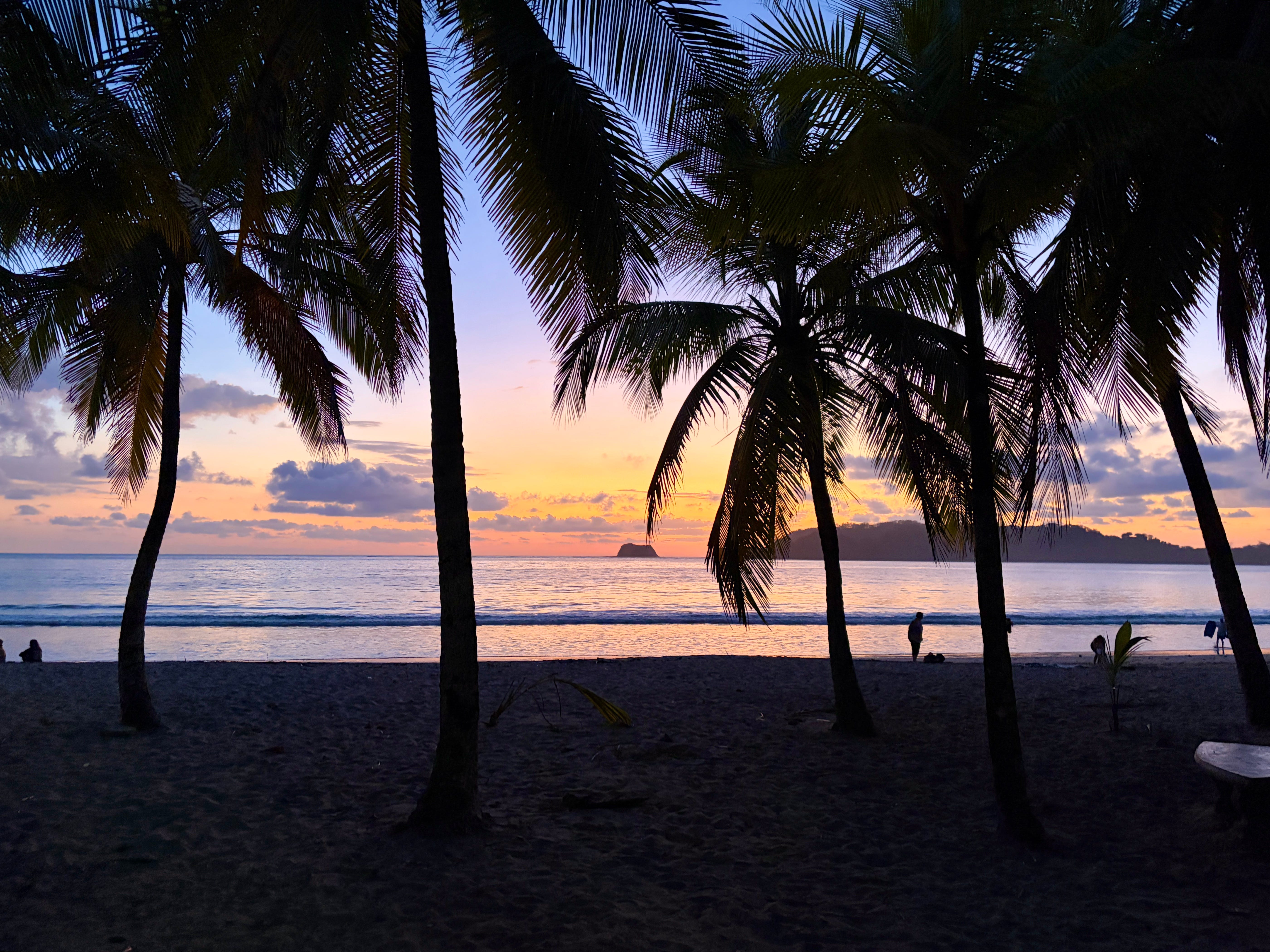
But the biggest thing I take away from Costa Rica each year is not the beautiful beach or picturesque sunset, it’s something less tangible. It’s the contrast with my life back in the States.
Here’s what living in Costa Rica has revealed about my American life:
1. A Break from Consumerism
My wife and I joke that being down in Costa Rica saves us money. In some ways, it does, especially when you factor in childcare costs. But there’s a simpler reality at play—We don’t spend as much money because we can’t.
We aren’t shopping. We aren’t upgrading our home. We aren’t spending money on events or entertainment because, quite frankly, there isn’t any. There are no boutique shops. No ads or billboards to pique our interest. Even Amazon’s ubiquitous delivery network can’t reach us here.
This shift is massive.
It breaks the “consumer” mindset ingrained in American culture. In the States, I am lured into buying things because the culture is designed to provoke my discontent and cultivate my desire, and then the infrastructure exists to sell me endless solutions at the click of a button.
I’ve always known we are a nation of consumers, but after a month away from it, I noticed I wasn’t just consuming fewer products in Costa Rica, I was also consuming less media: fewer podcasts, news articles, or shows.
The absence is the point.
When my surroundings are not trying to capture my attention, my desires, and my wallet, things simply are what they are. I don’t feel the relentless tug for more—more stuff, more status, or more knowledge. I don’t have to fill the gaps in my day with acquiring. I can just be.
And this opens the door for a different kind of consumption.
I consume birdsong in the morning.
I consume the brushstrokes of pink and magenta clouds at sunset.
I consume the geometry of hermit crab trails and the quiet industry of ants.
There is a richness to this consumption because it isn’t transactional. These creatures aren’t trying to put on a show. They don’t know I’m watching with gleeful joy.
Nature offers this abundance of marvels freely, but it makes no promises. If I’m paying attention, I receive it. If I’m distracted, I miss it. There are no guaranteed dopamine hits.
I fully recognize that I’m not the first person to stumble upon the sublime delight of watching nature. Yet this is a pastime that is largely past its time, and one that I’ve mostly forgotten about as an urban dweller.
I think about what this teaches my son. Not by instruction, but by atmosphere. What he learns in Costa Rica is not how to buy, but how to notice. Not how to accumulate, but how to belong to a place, and that feels like a rare inheritance.
2. Standards (De)flation
Some people romanticize a weekend without a TV or a few days off the grid. It’s nice to escape the din of modern life. I’ve always valued camping or backpacking for exactly those reasons. It’s the irony of an affluent modern life: “anti-luxuries” have become luxuries of their own.
Living in Puerto Carrillo takes this a step further. The home we rent, while comfortable, has no dishwasher, no vacuum, no fancy appliances, and no flushing paper down the toilet. We cohabitate with the ants, spiders, geckos, iguanas, and other jungle creatures that were here long before us.
Why does this matter?
It breaks the spell of chasing comfort.
In the game of modern conveniences, the treadmill towards ever-greater ease is endless. It’s what my wife and I call “standards inflation”: what used to be a luxury becomes a baseline; what used to be satisfactory now seems inadequate.
While there is nothing wrong with nice things, when you're surrounded by them all of the time, you adapt. It’s human nature, and the result is dependency. The world you deem “acceptable” shrinks. And when reality falls short of your inflated standards, dissatisfaction follows.
The solution is an occasional and temporary ‘standards deflation’. Deflating standards can be uncomfortable, yes. But it also expands freedom—it resets what is truly important.
Yes, a dishwasher would be nice. I miss it. But my mood doesn’t depend on it. My well-being doesn’t collapse without it. That distinction matters.
I’m not claiming I want to live without creature comforts forever. (It’s nice to have a washing machine that actually cleans our clothes.) Standards deflation need only be temporary to work its magic.
Moreover, there is an important truth baked into this whole experience: the idea of discomfort is worse than the discomfort itself. We can handle more than we think.
3. A Return to Solar Time
In Boston, I operate in a grid of 60-minute blocks—“Google Calendar Time.”
Time is a resource to be managed, filled, and optimized. Hours are money. When the clock strikes top of the hour, it’s a hard stop and a fast transition. On to the next task.
In Costa Rica, there is a gentle return to “Solar Time.”
We don’t abandon clocks entirely. We’re still working remotely. I still have calls that have to happen on the hour.
But the days feel different. I don’t think in sixty-minute blocks as I do in Boston. Time matters, but it doesn’t dominate. I’m not inhabiting the day through the lens of productivity opportunity costs.
I wake with the sunrise, not because an alarm demands it, but because my body senses the day beginning. The early mornings are exquisite. Cooler air. Howler monkeys and birdsong. A slow gathering of energy as the jungle wakes.
By midday, the sun is so intense that it physically nudges us into the shade. Lizards emerge to soak up the noon heat. I don’t stop working because it’s “lunchtime”; I stop because my body is fiending for a cooler spot and change of pace—Something older than a timepiece is in charge here.
In the evening, the beach calls us back. Not because an app says the UV index has dropped, but because the clouds gather on the horizon and the light changes. The sky says, watch and be rewarded; my beauty is spectacular.
After sunset, the rhythm shifts again. Returning home. Powering down. I am just another animal in the ecosystem preparing for rest.
The result of solar-based living is not only less hurry and worry, but better sleep. My wife and I always comment on how easy it is get a good night’s sleep (aside from the jungle noises which can be unsettling at first).
My body feels ready for bed because I’ve been riding the natural ebb and flow of the day—my circadian rhythms are happy: cortisol and melatonin are fluctuating as nature intended.
4. Decision Anti-Fatigue
Barry Schwartz coined the term “The Paradox of Choice”—the idea that endless options often lead to more anxiety rather than more happiness.
At home in Boston, nowhere is this more apparent than in answering the question “What’s for dinner?”
Deciding what to eat unlocks a paralyzing matrix of options. Infinite cuisines, delivery apps, and customizable bowls. It is both a beautiful abundance and a cognitive overload. Modern American eating—what I call Food 2.0—is a system that trains us to confuse convenience with contentment.
Here’s the real danger: Food 2.0 erodes satisfaction. And a lack of satisfaction sends us running back for more stimulation and consumption—cue the mindless snacking and endless scroll.
In our tiny Costa Rica town, the choices are beautifully constrained. We’re not choosing between dozens of dining options. We’re not comparing meal deals or menus. We’re barely choosing it all.
There are a few restaurants: one serves steak, one serves pizza, and the others offer platos típicos (rice, beans, plantains, and protein).
There is basically one supermarket. If you go at the wrong time, the shelves are bare. The vegetables are limited. You might find what you want. You might not. Creativity becomes necessary. How many ways can we cook plantains and beans?—Let’s find out.
The anti-decision fatigue extends beyond meals. In the morning, we swim because there’s no better place to be than in the ocean. When the late afternoon rolls around, we don’t deliberate on plans. We go back to the beach to watch the sunset. It’s a done decision.
This lack of choice provides a structure, and within that structure is freedom. I am not caught in a swirl of “what else?” or “what if?” Cognitive overload evaporates, and decision fatigue vanishes.
With fewer trade-offs to analyze, I have more bandwidth for what really matters: family, frolicking, and a deep appreciation of nature’s beauty. We’re not spending our energy choosing; we’re spending our energy living—The difference is palpable.
5. Analog Stimulation
Modern life is hyper-stimulating, but it’s a specific kind of stimulation: digital, visual, and cerebral. We are heads on sticks, staring at screens while our bodies remain numb.
In Costa Rica, the stimulation is embodied and analog. It is the sun’s intense heat. The silken mud of the wet sand. The saltwater drying on my skin. The smell of ripe pineapple and mango.
My body isn’t just seeing and thinking, it’s feeling—a lot. This multi-sensory environment creates deep embodiment. My nervous system isn’t dysregulated by spending all day managing threatening headlines; it is co-regulated by the rhythm of the ocean’s touch and the ground beneath my feet.
Speaking of feet, I rarely wear shoes in Costa Rica. Just flip-flops or barefeet. It keeps me grounded in a way that wearing sneakers on a sidewalk never can. I can feel the rocks, the sand, the hot asphalt. It’s a reminder for my mind to be where my body is, not drifting away to some far-off land.
For many hours of the day, I’m dirty. I’m sandy. I’m sweaty. These are sensations I rarely encounter in the clothed, clean, temperature-controlled setting of home. But there’s something quietly stabilizing about being in a body that sweats, strains, and touches the ground.
Watching Asher move through this world, dirty, barefoot, and unbothered, I’m reminded that comfort is learned. We don’t have to get all upset when things are wet or dirty. We don’t have to care so much whether our clothes are sandy or our bodies are muddy. We have to unlearn learn our opposition to it.
The Professional Irony
There’s a deeper irony here that I can’t ignore.
I make my living helping people regulate their nervous systems. I teach embodiment, mindfulness, and presence. I help men step out of compulsive consumption, recalibrate their stress responses, and rebuild rhythms that modern life quietly erodes.
Yet in Costa Rica, I would barely have a job.
The land regulates. The culture enforces the easygoing “Pura Vida” pace. The constraints on consumption create the conditions for presence.
When you spend nearly your entire day outdoors, your nervous system regulates. You don’t need breathwork protocols or meditation apps because the environment itself has healing rhythms.
This was the default for most of human history.
Before artificial light. Before climate control. Before infinite choice. Before work sent us online, staring at screens, pushing pixels.
In our efforts to smooth out any and all unexpected discomfort, we’ve inadvertently steamrolled our core vitality and adaptability. We’re trying to optimize individuals inside systems that quietly undermine them. My job centers on this rescue mission.
Some days, that feels like purpose. Other days, it feels like patching leaks in a ship that won’t change course.
I haven’t resolved that tension yet. But I no longer pretend it isn’t there.
And it raises an uncomfortable question, one I sit with every time I walk barefoot down the beach.
The Uncomfortable Question
Can we really ever be “well” inside a fundamentally unhealthy culture?
We only need vitamin supplements when the soil is depleted. We only need sleep hacks when our nervous systems are chronically dysregulated. We only need workouts-of-the-day when the default is a completely sedentary lifestyle.
That is the sad state of affairs.
I grieve what we’ve lost, even as I benefit from what modernity has given us.
I believe in progress. I also believe something essential has been lost.
I believe in agency. I also see how much choice exhausts us.
I’m trying to live honestly inside those contradictions. Not solve them. Not deny them.
I am trying to figure out how to reclaim some of the range and novelty that were once the norm.
And yes, I like saunas and cold plunges, but something about these kinds of modern wellness trends feels like a band-aid for a deeper discontent.
What I long for is wellness that is not a product or a practice, but an emergent property of a lifestyle rooted in a community, rooted in a respectful relationship with the land. I know this is starting to sound like a retreat to some hippie-dippie commune, but that’s not it. And to be honest, I don’t know exactly what it is.
I guess that’s the point of this whole Substack.
I’m still figuring it out—in-formation—neither here nor there.
If that’s you too, we’re in good company.
Pura Vida + Wicked Smaht
~ Jeff